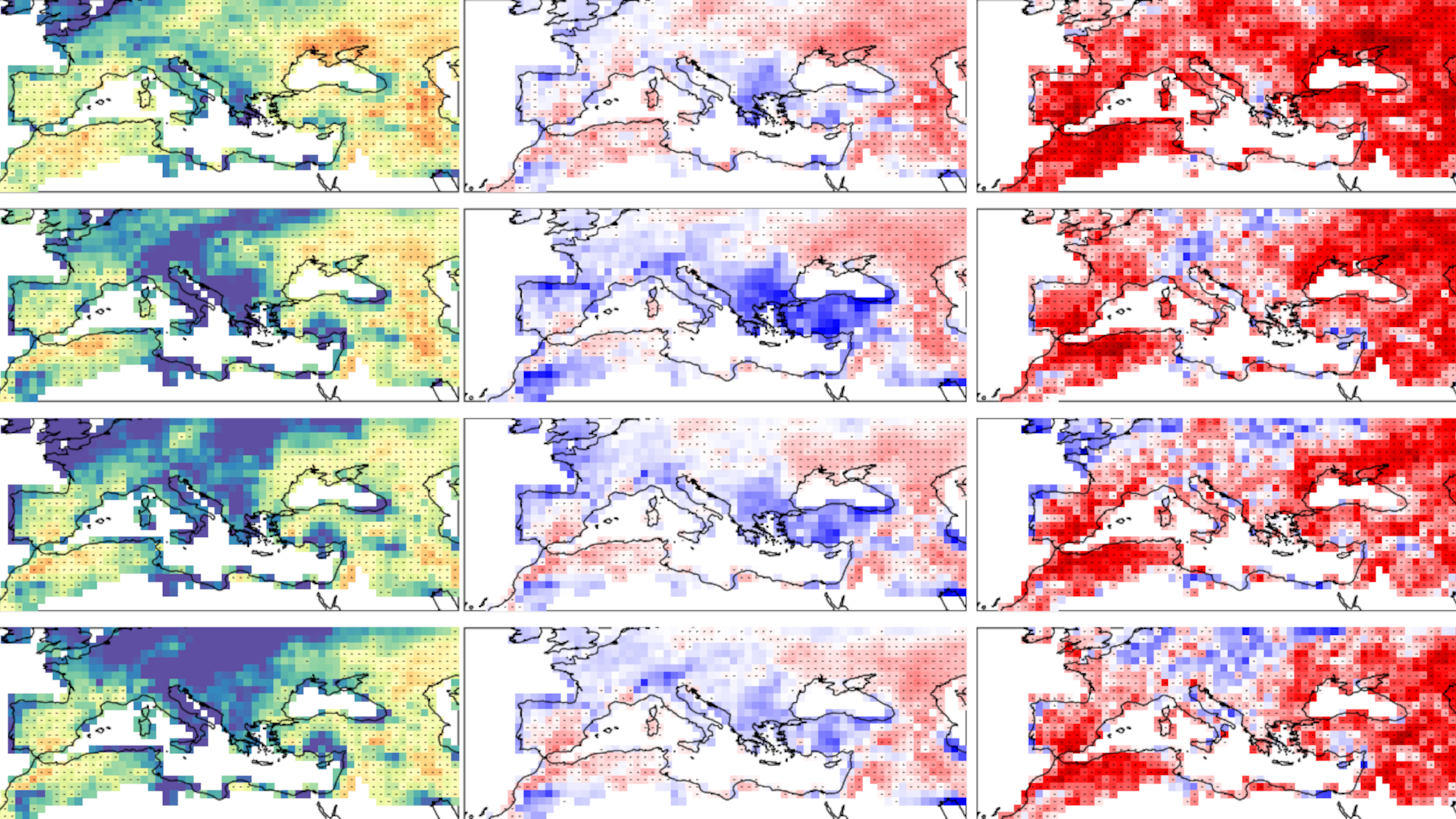
The Standarised Precipitation and Evapotranspiration Index (SPEI) is an essential tool for monitoring meteorological droughts, since it tracks the delicate balance between rainfall and evaporation. Our colleague Jaime Díez has co-authored a recent study that has found a more accurate way to predict droughts…
The integration of SPEI with seasonal forecasting is particularly vital; by looking up to six months ahead, it allows us to anticipate shifts in water availability, providing crucial lead time for strategic planning in sectors like agriculture and urban water management.
For the case study Jaime worked on, ECMWF’s SEAS5.1 seasonal prediction system (Johnson et al., 2019) at daily scale was used, available on a monthly basis via Copernicus Climate Change Service's Climate Data Store. Downloaded daily data are aggregated at month scale. Each SEAS5.1 monthly publication contains a forecast for the first month and the following six, allowing us to calculate the SPEI for that timeframe.
However, in order to obtain these forecasts, it is essential to account for the antecedent conditions—the information related to the hydric situation of the previous months. In this case, 3 of them, that’s why we’ll be talking about SPEI-3. For this precise reason, it is necessary to backfill those time periods – this will allow us to obtain forecasts for the first two months. This can be done in two different ways:
- Using SPEI-3-R, based on high-precission ERA5 reanalysis data.
- Using SPEI-3-M, based on forecasts from the model itself published in earlier months.
The study found that while SPEI-3-R offers strong association and discrimination, it suffers from low accuracy due to significant biases between reanalysis and the model. In contrast, SPEI-3-M maintains much higher accuracy by ensuring internal consistency, making it the recommended approach for the operational services deployed within the Interdisciplinary Thematic Platform for Climate and Climate Services (PTI+ Clima).
The PTI+ Clima, of which Predictia is a partaker, is a Spanish National Research Council (CSIC) initiative dedicated to advancing climate research and providing reference climate services to key sectors like water, agriculture, and biodiversity.
As technical partners in this platform, Predictia has actively contributed to the operational deployment. We have automated the download and processing of massive meteorological datasets and implemented these calculation algorithms to ensure the drought indices are updated in real-time. To ensure this data is accessible to everyone —from researchers to policymakers— we are developing an intuitive web viewer that transforms complex climate data into actionable intelligence for a more resilient future.
You can read the paper in the following link: Brands, S. et al, 2025. Seasonal drought predictions in the Mediterranean using the SPEI index: Paving the way for their operational applicability in climate services.
And should you need to reach out to our team for services such as a the aforementioned, do not hesitate to email us on predictia@predictia.es o via any other means such as the one made available on our Contact section.